

Chicago & RSNA 2026: Time to grow and expand.........
If you are a Canadian, US, Latin America, Oceana Distributor then please read on.

Growth, Partnership and a True SaaS RIS: Aptvision in 2026 and What Comes Next
2026 has been the most expansive year in Aptvision's history. We added new deployments across European markets, established a real presence in Canada, and spent the year learning from the organisations that are hardest to serve well: private diagnostic groups running imaging across many sites at once. That experience has shaped everything we are building for 2027.
A year of growth in Europe and Canada
Our European business grew on two fronts. A steady stream of greenfield projects came from private providers building new imaging capacity, and alongside them we saw growing demand from organisations replacing legacy RIS platforms that could no longer keep pace with how they actually operate. In parallel, Canada became a second centre of gravity for us, with the same pattern emerging: ambitious diagnostic operators who need one system to run a network of clinics rather than a departmental tool bolted onto each location.
What stood out across both markets was consistency. The problems a four-site clinic group faces in one country turn out to look remarkably like those faced by a twenty-site group in another. That is encouraging for anyone evaluating us from a new territory, because it means our roadmap is not shaped by the requirements of a single national market.
Why multi-site private groups keep choosing us
Several of our European clients now run twenty or more locations on Aptvision. Supporting that well is a different engineering problem from supporting one hospital department, and it is the problem we have optimised for. A patient belongs to the group rather than to a clinic, so their history travels with them wherever they are seen. Scheduling can be managed centrally while still respecting the realities of each site's modalities and staffing. Reporting pools are shared, so radiologist capacity can be balanced across the network instead of stranded behind site boundaries. Protocols, templates and billing rules are governed once and applied consistently. Leadership gets one view of utilisation, turnaround and revenue across the whole estate.
Legacy systems designed around a single hospital department rarely stretch to this without heavy customisation, parallel databases and manual reconciliation. That is the gap we see most often in replacement projects, and it is usually what prompts the conversation in the first place.
2027: making RIS adoption effortless
Our central goal for 2027 is to remove the cost and effort that still stands between a smaller clinic and a modern RIS. Historically, adopting a RIS has meant a lengthy implementation project: discovery workshops, configuration by the vendor, data migration, training, and a professional services bill that can rival the software itself. For a large group that investment makes sense. For a two-room private clinic, it has been the reason to carry on with spreadsheets, paper or whatever came bundled with the scanner.
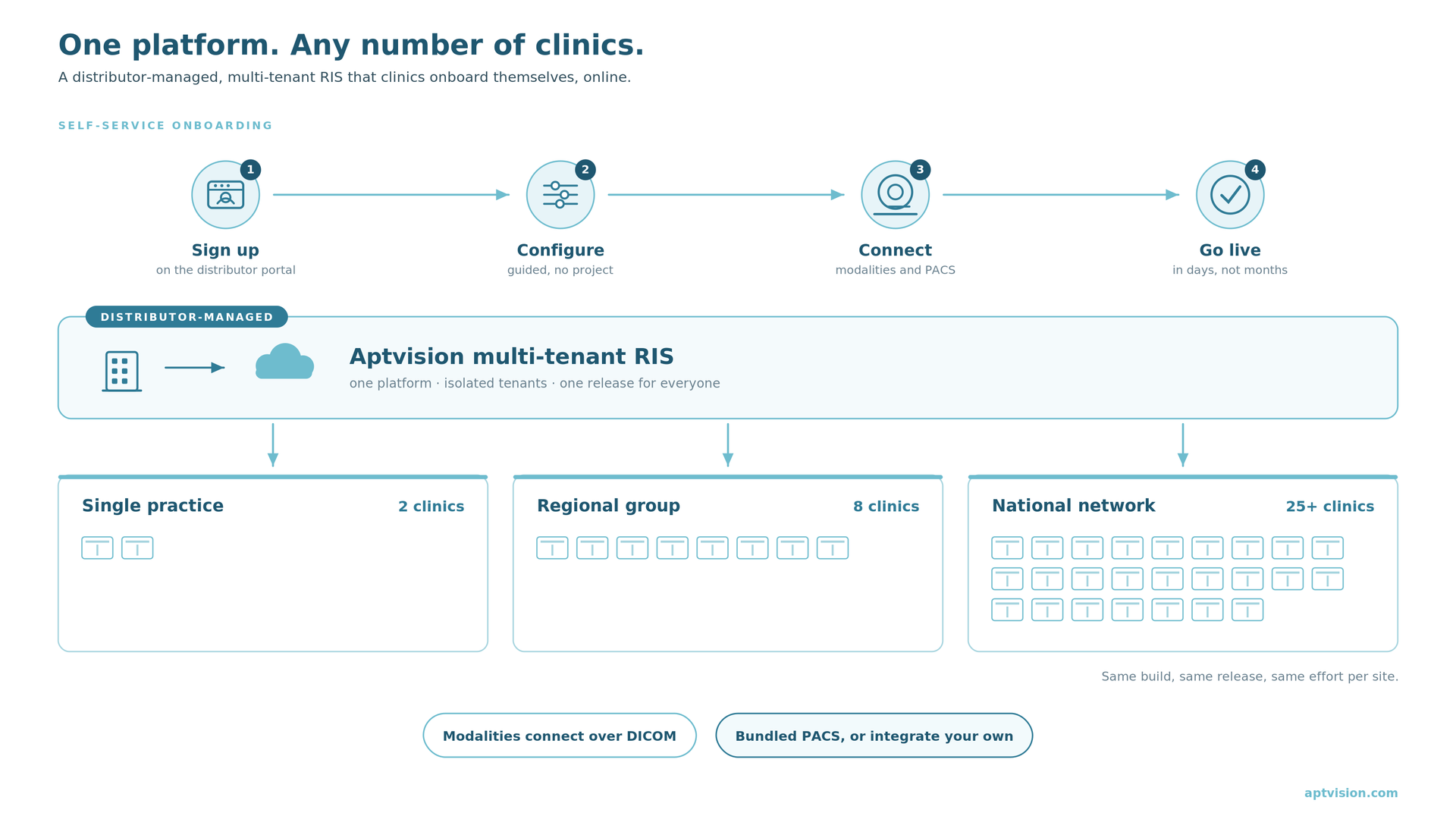
We are changing that by making our cloud platform fully self-service. New tools now in development will let clients and partners onboard themselves: create the organisation, define sites and rooms, connect modality worklists, set up users and roles, load report templates, and configure billing rules through guided workflows rather than a vendor-led project. Pricing follows the same logic, on a subscription basis that scales with the clinic, so there is no large upfront commitment to justify. This is a true SaaS model in the way the term is meant, not a hosted version of an on-premise product.
An opportunity for PACS vendors, modality suppliers and distributors
Self-service onboarding changes what is possible for our partners, and beyond our established markets, this is where we are focusing commercial energy in 2027. If you already sell PACS, modalities or clinic infrastructure, RIS is frequently the missing piece that decides a tender or opportunity. Buyers increasingly want to procure a complete operational practice management and imaging solution rather than assemble one, and the supplier who can present scheduling, worklists, reporting, patient engagement and billing alongside imaging hardware and storage is in a materially stronger position.
Wrapping Aptvision around an existing portfolio lets a distributor do exactly that. It raises win rates on combined PACS and RIS opportunities, it makes a modality proposal more complete, and it adds recurring subscription revenue to what is often a capital-sale business. Just as importantly, self-service tooling means a partner does not need a large implementation team to deliver it. Onboarding a small clinic becomes something a commercial team can do, which makes the smaller end of the market commercially viable for the first time.
Continued investment in localisation and automation
Entering new countries is as much a product challenge as a sales one, so localisation remains a standing investment: language, local coding and classification standards, billing and insurance models, and the reporting that each health system expects. The faster we can make a new territory feel native, the easier it becomes for a partner there to sell with confidence.
The second investment area is automation and engagement. We are extending workflow automation so that routine coordination between referral, scheduling, acquisition, reporting and results delivery happens without manual chasing. Alongside that, we are applying newer technology where it removes real friction rather than for its own sake: voice agents that can handle booking and routine patient enquiries, and engagement through the messaging channels people already use, including WhatsApp, for appointment confirmation, preparation instructions, reminders and results notification. For referrers, the same thinking applies to order submission and status visibility. The measurable goals are fewer missed appointments, less administrative load per study and a shorter path from referral to report.
Where we are looking for partners
The single and multi-site private diagnostic model we have supported in Europe maps closely onto Canada, the United States and Latin America, where independent and group-owned diagnostic centres are consolidating and professionalising quickly. We believe that is a strong fit for what we have built, and we would rather enter those markets with partners who know them than attempt it alone. If you distribute imaging technology in these regions and want a RIS to complete your portfolio, we would like to talk.
Come and talk to us
Our team is at RSNA in Chicago from 28 November to 3 December, and we would be glad to show you the platform and discuss where it fits, whether you are planning a new imaging service, considering replacing a legacy RIS, or looking at adding RIS to what you already sell.
To arrange a meeting at the show or a demonstration at any time, contact us at [email protected] or visit aptvision.com.
The Model for Partner & Distributors

Each Distributor has their own country or region specific instance and will be able to assist clients in signing up to the service, configure their workflow, make the connections and start gathering images and reporting. Wrap around advanced services such as data migration and specialist integration or hardware can be provided by the distributor.